Sunday, 23 November 2014

Pre-Production Work 2

Carrying on from the last post I have since created several more blockout models in 3DS MAX based on my concept thumbnails, not worrying about correct topology and just getting the general shapes in. However in addition to this I also started to 'kitbash' models together, which is where I took parts from different models and put them together. Additionally I created new pieces for the kitbash models to to work with, in order to create more interesting designs and overall more variety as well. There are a total of 7 kitbashed robots, which will be marked out by KB.

Left to right: Mech 23, 26, 27 and 34

Left to right: Mech 20, 25, KB1 and KB 2

Left to right: Mech  KB2, KB 3, KB 4 and KB5

Left to right: Mech KB 6 and KB 7
I found that the further I kitbashed the more interesting the shapes and designs of these robots became. I constructed designs based around tanks, diggers and excavators, which additionally made me think about how they would fit on to my designs, giving me the slight realistic aspect at this stage of development. Once each model was finished, I used the group function in 3DS MAX to make it easier to move all the pieces around at once.

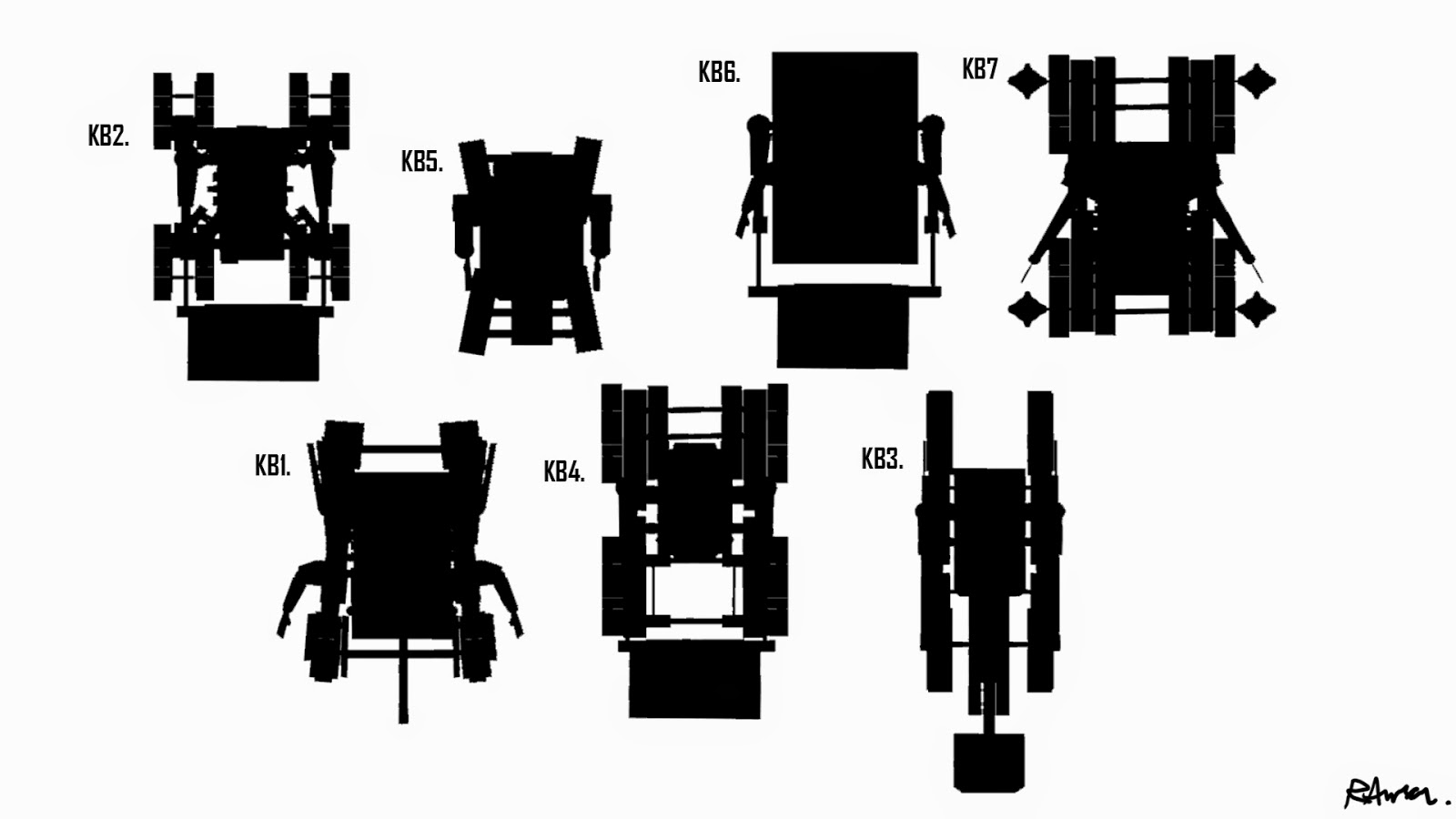
I also decided to create silhouette models within 3DS MAX in order to see if their shapes worked as well as their design. To do this, I turned the shader scheme onto 'consistent colours', duplicated the finished robots and made them black. I then placed two white image planes in the scene for a clear background. From here I simply captured still images, put them into Photoshop and placed them with groups. I took both side and top views so that I would be able to analyze their shapes from more than just one angle. Note the numbers represent either their thumbnail placement or which kitbashed robot they are.


From doing this I found a lot of them had a strong side profile, however when it came to the top view models that had components such as tank bases, they looked a lot weaker, so I decided that they wouldn't be considered strongly for the final designs. Also the two legged robots from a previous post wouldn't work in a realistic sense, so I've chosen to ignore them as well.

My aim now was to minimize the number of robots that I would use to continue my development work. I found it a little difficult to choose at first, so instead decided to ask a few people round the labs which ones they would choose, and eventually got a voting system going wherein I would show them all of my designs, and they would pic their favourite four, so that whilst reducing the number of robots, still giving me a fair amount to work with. I voted as well so that I could compare my favorites to everyone else's.

This also helped as it gave me a perspective on what other people though were cool robots, as well as ones that they believed to be functional for my project idea.

The results of this and the people who took part are listed below (Note in the survey the robots are listed from 1 to 14 and not by their respected thumbnail or kitbashed numbers)

People who took Part:
Robert Anson, Caitie Graham, Will Ahmadi, Luke Dawson, Stephen Reeson, Mike Taylor, Jamie Reynolds, Joel Holgarth

Results:
.1 0 votes
.2 1 vote
.3 3 votes
.4 5 votes
.5 2 votes
.6 3 votes
.7 0 votes
.8 7 votes
.9 3 votes
.10 2 votes
.11 2 votes
.12 0 votes
.13 2 votes
.14 4 votes

So as you can see some robots were completely ignored, some were agreed on, and others were liked really well. So based of the votes cast, and my on decisions on some of the tied ones, I decided upon the final robots to use for further developmental work, as you can see below.

The final four: Top Left Mech 26. Top Right Mech 27. Bottom Left Mech KB1. And Bottom Right Mech KB 7


So with these basic blockouts out of the way, the next post will deal with further concept art and research done for the robot mechs.

Sunday, 16 November 2014

Areas of Research

In this post i'll show you the research that I have done so far and am going to continue to do throughout the project. I find that doing all the research at the beginning and then leaving it would be pointless, as you'll always look up new links and videos for help in certain areas your work. But for now this'll give you an idea of how and where I started.

First thing to do was to decide what reference I could research, with the obvious choice being robots and mechs in games. However I expanded this to general robotics, as I feel this will give me a bigger field of scope for my current project and for future works.

I quickly made lists on the online software Evernote, where I store a lot of my useful links, info and notes that I find from around the web. Heres one example of robotics found in games. I aim to do this with other areas as well:


So from this I decided to start off with robots and mechs found in games, but also in real life. At the basic level of research I wanted to look at images and appearances in real life and media, compiling a visual library of them until eventually I could draw out the images not needed and bring a focused group of them together. For the current project, where im looking at robotics in 4 main areas currently: Animal Based Robots, Human Enhancements, Mechs and Robots. From there I further split each category into films, games, real life and TV. Examples of these are shown below.

Robots from Games, which has a rich variety of designs and shapes.

Mechs from Games, again although not as many as robots, still quite a few to choose from.

Mechs From Real life, which have far less to choose from, showing how difficult they are to create.

Robots from films, again another area with lots to choose from.

Animal based robots from games, a fair few to select from, but they provided a few interesting shapes to the palette.
So far from just this selection I have gained a fair bit of insight into the world of robots, all areas showing casing different levels of design and function. This image database is far from finished, as their are still areas that need to be explored, titles I may of missed, and areas of research I haven't added in yet (Such as toys and art from the internet.) But as well as helping me with this project, it will be a fantastic resource to explore in future use.

For general research I decided to start off with realistic robots as they will be key to my own designs. To this end I looked up robotics companies, and found a great selection of up to date modern ones to choose from. Below are a couple of examples of this.
The Japanese Company Suidobashi Heavy Industries, showcasing their recent creation Kuratas in 2012. This robot was built purely for the fun of making it, and is heavily inspired by robot based Anime shows. 

Boston Dynamics, founded in 1992 Waltham Massachusetts, America. One of the largest leading robotics companies in the world, they have produced robots such as LS3, Atlas and Petman. They take inspiration from both the human and animal form.
These websites have given me a good insight into the various types of robots out there, how they were made and what they can do. It also shows that they are built for purpose, staying true to form and function, rather than robots found in video games, which are made to look cool and fantastical.

I've also read into gaming articles and found websites that give me the basic info that I need for my work. Since my FYP project interlinks with my Contemporary studies paper 'How does Implementing mechanical components affect function and design for robots in games', I've been able to find a lot of good articles that can be used for both areas. Below are a few examples of this:

Gamasutra is a great website with articles on current work from industry professionals and companies, as well as info on the latest games and game tech. 


HowstuffWorks is a website that explains, well, how stuff works. In this article it talks about the robots today, what their made from, how they work, and what jobs they were created for.
Also game websites such as the website for Hawekn, an online mech FPS. These give me useful info on their designs and functions, how they can be customized, specs, and further ideas for my work.
Also through general research i've found some good websites that will help me with the artistic look I want to go for. One example is bulldozer vfx, a website that makes their robotic designs look incredibly realistic and detailed. I'll be making sure to use this one for my future work.

A general look at the websites work.
A mech creation, very handy for the work that I am doing. 
So far I feel that all of this research has been incredibly handy to my work. Its given me an insight into hundreds of designs, and has also forced me to consider real life science and design when thinking about how to go about making my own robot. Although I have yet to compiled some of this information properly, brief readings of it tell me that I'll be design and model robots with a greater understanding once this project is over.

For my last point, I tend to save most of my useful links and the odd gem on the Evernote software. In addition I have also started a library of  useful terms for my contempoary studies paper, which has come very handy in relating to my FYP work, as shown below:


So for now this post concludes the amount of research that I have done to date. Not all of it is on here, but as I stated at the beginning enough to give you a rough grounding in how i'm going about it. For any goo discovery's related to my artwork i'll be posting them in other posts as I go along. 

However, for the next blog entry I aim to show more pre-production work and further development of the robot's concept. 


Beginning of Pre-Production Work

Carrying on from the last post entry, this entry covers the beginnings of my pre-production work.

To start with I created a moodboard image that gives you a general idea of the kind of robot that I want to create.


As you can see i'm aiming for a chunky/blocky robot, as through finding these images the more realistic end of the robot spectrum in games reflect the real life blocky shapes of construction and military vehicles. Anything with rounded or smoothed shapes tend to be more fantastical and unrealistic, or are just not what i'm aiming for in the design.

 I want to make it pilotable by a human driver as well as an A.I., as I feel this will increase the customization aspect that i'm driving for in its design. Its also given an idea of what parts i'll need to consider and model, such as pistons, tank wheels, metal poles and more complex parts made up of multiple pieces such as an engine.

Additionally it gives you ideas of work pieces I want to try and develop during the art pipeline, such as a blue print sheet and a rendering system that shows a scanning of the inner parts.

After this the next step was to create lots of thumbnails!


I had fun doing the different variations on the design and shapes based off of research that I have look at alongside designing these thumbnails, from games such as Metal Gear Solid, Mechwarrior and Armoured Core. Although two legged isn't as realistic for a giant robot design I decided to explore it in order to gain ideas for further designs.

In particular I'm focusing on the four legged/wheeled designs, as they offer the best results for a realistic look.Tanks and construction vehicles such as diggers, extractors and the challenger II tank were particularly helpful for realistic reference.

So from these thumbnail designs I decided to create some basic 3D thumbnails to see how they would look within 3DS MAX.

Thumbnails 3, 1 and 7 in Max.

Thumbnails 11 and 17 in Max.

Thumbnails 19 and 22 in Max.

My reasoning for starting 3D models so soon is that I don't want to constrain my pre-production to just 2D. Modelling initial ideas in 3D allows me to see if their are any mistakes or if tweaking is needed in the design. For these models proper geometry and vert/edge placement at this point doesn't matter. Its mainly to give me an idea of the shapes, silhouette and how they could all be pieced together. Like this example shown below.


Whilst the bi-pedal robots have interesting designs, as I mentioned earlier  for the sake of realism and functionality i'm going to stick with the four legged/wheeled.tread look. However the torso work for the bi-pedal robots will still come in handy at the very least. 
For my next blog entry that includes pre-production work it will continue to focus on 3D Work and further conceptual work.

In the meantime the next blog entry will give you an idea of the research that I aim looking into alongside the artwork that I am producing.


Sunday, 9 November 2014

The FYP Project Proposal

Hello there and welcome to the first post of many that will encompass this final year project blog page! My name is Robert Anson, a 3rd Year BA Computer Games Art student currently studying at Teesside University in Middlesbrough. This blog covers my work in the games practical project module in which I have to produce an artefact/deliverable product on a subject area of my choice roughly over the course of the next four months or so. So without further ado, let me introduce you to my project idea!

So basically for the first part of the October month we had to come up with a proposal title for our FYP idea. After much consideration on this, this is the title that I decided on:

Robotic Realism in Games
" A Study at implementing real life robotics into Concept Art and 3D Modelling of Robot Designs in Modern Video Games"

I chose this title as robots in games have interested me for a very long time now. I love how sometimes their complex, sometime their simple, but yet both can still look cool and partially functional at the same time. Now I've mainly drawn 2D Concept art of robots mainly for the past few years, and would love to transfer my skills of this properly into 3D programs such as 3DS MAX. This project will give me a chance to do both.

However as the title states, I want to make the robots I design for this particular project to be realistic. I feel that a lot of games make robots in games look cool and awesome, which I love, but not functional, not like they could work in real life. Sure some games try to hit the mark to reflect their art style, such as the recent Call of Duty Advanced Warfare or the giant fire powered behemoths from the Mech Warrior series. But I want to see if I could design a robot or Mech that has a high chance of working in the real world.

To this end I made the proposal fit the purpose of my idea. The next few sections will show you how I aim to achieve this goal, and what steps I've already taken in my pre-production work to date in order to prepare for the work ahead. So some parts of my completed proposal will appear in this entry, whilst others I want to go into a little more depth about.


Research Ideas

Having explained why I want to do this project, and the basics of what i'm making, the next logical step would be to decide on the areas of research to look at. The first obvious step of course would be looking at robots in games! Whilst most of these wouldn't work with the realistic aspect mechanically, I still want to reference them for art styles and potential part influence. I quickly whipped together these two pages of robots, vehicles and mechs from games in which to gain insipiration from:

Some of the titles these robots, mechs and vehicles come from include the Metal Gear Solid games, Sonic titles, the Armored Core series, the Borderlands franchise and MechWarrior to name but a few. 

As you can tell from just the small collective of robots, the games industry has a lot of colourful and cool looking robot in which I can take inspiration from. I've noticed the majority contain lots of blocky shapes, which is pefect for the kind of robot I want to create, which I'll talk about later on in this post. Addtionaly a lot of robots/mechs are based on the human form, with them acting as futuristic gigantic suits of armour for the user. I'd like to emulate this in my own designs, although the bi-pedal aspect of this may not work in a realistic design due to weight and strain consideration on the parts needed. 

For the realistic part of this work I've been looking into real life robots to see how they match up to their video game counterparts. I've found that a lot of them are vastly different and a lot more complex in their inner workings and shapes. I've largely been looking at robotics companies in this regard, which include leading technologists such as Boston Dynamics and Rethink Robotics. Below shows some examples of what I will be researching.

Top left: Kuratas, Top Middle 1: Baxter, Top Middle 2: PETMAN, Top Right: Bigdog, Bottom Right: MARS Rover, Middle 2: Atlas, Middle 1: KUKA Robtics, Arm Bottom Left: ASIMO.

Already from this selection of robots you can see the difference between them and ones found in video games. The inner workings are clearer to see and all of these robots work in real life. However I still find the designs look cool and the variety is clear to see. Although again the humanoid form is still followed, its followed in a way in which the robots can really function, and i'd like to take this on board with my own work. 

However my research doesn't stop there. I aim to look into the workings of car parts, engines, the actual anatomy of these robots, what materials are used and what role they perform, tank parts, and much more. So although there's a fairly wide scope to look at, it can all be brought back into one focused area. 

The Creative Pipeline
So with the research areas selected, the next section from the proposal is the technical overview, or as i'm labeling it, my creative pipeline. This section basically covers how I aim to go about creating the robots I want to make. Here's a screenshot snippet from the proposal itself to give you an idea of how I aim to make this project work:


I've also created a more artistic moodboard of this to give you a visual idea of how I want this progress to work:


In addition to these images, heres a selection of the software I aim to use or explore the potential of throughout the Project:

. CS6 Photshop (Adobe)
. 3DS MAX (Autodesk)
. Mudbox (Autodesk)
. Marmoset Toolbag (Marmoset)
. Crazy Bump
. XNormals
. Quixel Studios

What I aim to produce

So you've seen why I want to do this project, the research i'm looking into, and the work process I aim to use. So what kind of robot do I actually want to make? This extract from my FYP proposal pretty much covers my idea:


To add a little further detail, I want to create a realistic robot that can use interchangeable parts that function in both the construction and military industry, as both require strong, durable machines that can withstand certain conditions. In addition their often shared bulky structure and parts make them ideal for what I want to produce. I aim to make good use of my research and technical processes in order to make the final products of this project possible. 

Also, here's a project plan made in Excel that my proposal required in order to make sure that the project is on track. It takes into consideration term times, holidays and the other modules that I will be doing work on at the same time:


And with that ends the first entry of this FYP blog. For the next entry I will show the pre-production work that I have started on nailing the design that I want to create for my realistic robot.